
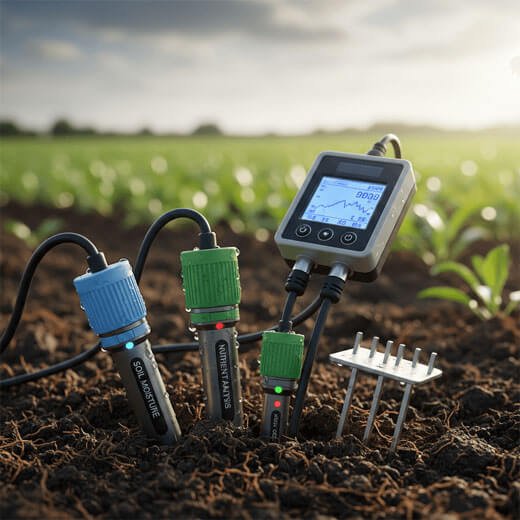
Description
What they measure
-
Soil moisture sensors measure how much water is in the soil (usually reported as volumetric water content — VWC — or as relative units).
-
Nutrient sensors measure concentrations or availability of soil nutrients (commonly N, P, K or electrical/ion activity related to those nutrients, plus sometimes pH and EC).
Common types & how they work
Moisture sensors
-
Capacitive / dielectric — measure soil’s dielectric constant; reliable, low-cost, low drift; good for consumer & ag use.
-
Resistive (conductivity-based) — measure electrical resistance between probes; cheap but corrosive and less stable.
-
TDR (Time Domain Reflectometry) — sends an electromagnetic pulse and measures travel time; very accurate and stable, used in research/farm automation.
-
FDR (Frequency Domain Reflectometry) — similar principle to TDR, often lower cost than TDR with good accuracy.
Nutrient sensors
-
Ion-selective electrodes (ISEs) — detect specific ions (e.g., nitrate, ammonium, potassium). Good for targeted measurement but need calibration.
-
Optical / spectroscopic sensors — analyze extracts or soil solution by light absorption; can estimate broader nutrient patterns.
-
Electrical conductivity (EC) / total dissolved solids (TDS) — not a direct nutrient reading but correlates with salinity and dissolved nutrient load.
-
Lab-style portable meters / colorimetric test kits — field-friendly, reproduce lab chemistry on-site with reagent strips or kits.
Typical specs to look for
-
Measurement range: VWC sensors typically cover the practical range for soils (dry → saturated). (Manufacturers list exact ranges.)
-
Accuracy / resolution: consumer capacitive ≈ a few % VWC; TDR ≈ better precision (often ±1–2% VWC). For nutrients, accuracy varies widely — depends on sensor type and calibration.
-
Output / interface: Analog (0–2.5V/0–5V), 4–20 mA, digital (I²C, SDI-12, UART/RS-485/Modbus). Choose based on your logger/controller.
-
Power: low-power options exist for battery/solar; check quiescent and sampling power.
-
Sampling frequency: continuous, user-programmable, or on-demand.
-
Probe length / depth: choose probe length that reaches root-zone depth you care about (e.g., 10–30 cm typical; longer available).
Installation & calibration (short)
-
Insert probes into undisturbed soil (no air gaps). Pack soil gently around probe.
-
For moisture: avoid placing probe in macropores or directly in a drip stream — gives biased readings.
-
For nutrient sensors (especially ISEs): calibrate frequently with standard solutions; nutrient sensors are sensitive to soil temperature, moisture, and ionic strength.
-
Record reference samples and occasionally confirm with lab analysis if decisions are critical.
Reviews
There are no reviews yet.